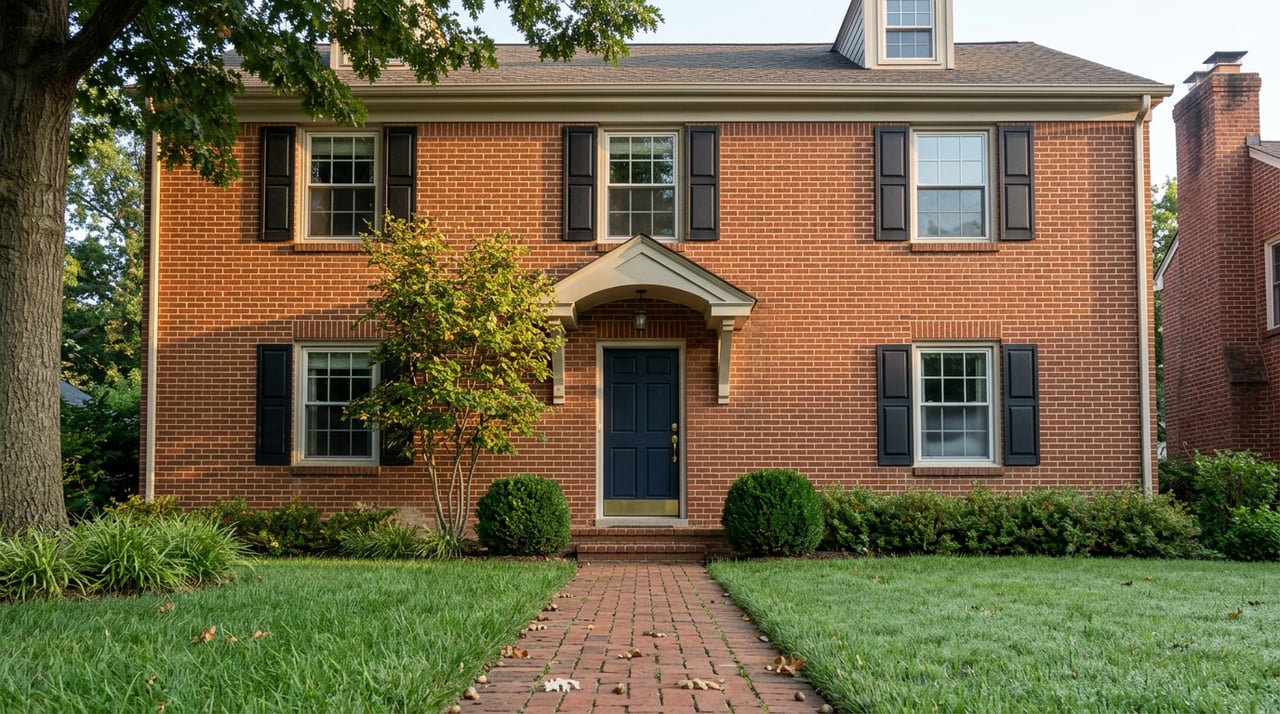
Two listings cross your desk. Both say "Falls Church, VA." Both sit inside a five-minute drive of the West Falls Church Metro. One of them answers to a seven-member city council that sets its own tax rate every spring. The other answers to the Fairfax County Board of Supervisors, feeds into one of the largest public school systems in Virginia, and just went through its first countywide attendance rezoning since 1984. Nothing on either listing sheet tells you which is which.
That is not a quirk. It is the whole story of buying in this part of Northern Virginia, and it is worth understanding before you fall for a house on the wrong side of a line you can't see from the street.
The City Is Two Square Miles. The Mailing Address Is Much Bigger.
The City of Falls Church became an independent city in 1948, split off its own school division the following year, and today runs its own government inside roughly two square miles. Everything outside that boundary that still gets mail addressed to "Falls Church" is Fairfax County: Merrifield, Seven Corners, and Bailey's Crossroads all carry the Falls Church name on an envelope while paying county taxes and following county services, according to the City's own Address Finder page.
The same page notes that most addresses numbered 1400 and above are outside the City, and that anything fronting Leesburg Pike, Route 7, Arlington Boulevard, Route 50, Lee Highway, or Route 29 is almost certainly county land, not city land. Established neighborhoods like Lake Barcroft, Sleepy Hollow, and Virginia Forest sit in this county-but-labeled-Falls-Church territory too. Lake Barcroft in particular is its own gated-feeling world: a privately owned 135-acre lake managed by a homeowners association since the 1970s, with five private beaches and a July 4th fireworks tradition, and it is entirely inside Fairfax County.
None of this shows up on a portal search filtered by city name. It shows up when you pull the parcel and check who actually bills you.
A Neighborhood That Renamed Itself to Match Its Own Confusion
Here is the detail that convinced me this deserved a full post instead of a footnote. In 2009, the area south of the City limits and west of Seven Corners was officially known as the Jefferson census-designated place. Residents wanted it renamed because, as one Fairfax County official later explained, their mail already said Falls Church and they wanted the map to match their envelopes. The Census Bureau can't assign a CDP the same name as an adjacent incorporated city, so after negotiation the area became "West Falls Church," a name that today sits south of the real Falls Church City and three miles from the West Falls Church Metro station itself, according to reporting from Greater Greater Washington.
So the confusion isn't an accident of postal history. Residents asked for it. That is worth sitting with if you are house hunting by neighborhood name alone: the name on the map was chosen to resolve a mailing dispute, not to tell you anything about which government collects your tax bill.
The Rate Gap Is Narrower Than You'd Guess. That's Not the Real Story.
If you assume the City is the expensive option, you are only about six cents per hundred dollars right. Falls Church City Council voted 7-0 in April 2026 to advertise a real estate tax rate of $1.185 per $100 of assessed value for the coming fiscal year, unchanged from the current rate and continuing a gradual decline from $1.21 two budget cycles ago to $1.20 last year, according to ARLnow's coverage of the April 13 vote. Fairfax County's base rate has held at $1.1225 per $100. That's a gap of about six cents on every hundred dollars of assessed value, hardly the chasm the postal confusion might lead you to expect.
The real difference isn't the sticker rate. It's what's happening underneath it. The City's total taxable assessed value climbed to just over $6.86 billion as of January 1, 2026, a 6.9 percent increase driven mostly by market growth rather than new construction, and residential values alone rose 7.2 percent, with single-family homes up 8.1 percent, townhomes up 7.0 percent, and condos up a comparatively modest 3.2 percent, per the City's own assessment office. Even holding the rate flat, a rising assessment means a rising bill, and the City Council itself has acknowledged that a flat rate still means the typical homeowner pays hundreds of dollars more this year purely from assessment growth.
That growth is not spread evenly, and this is the part a listing will never show you. An independent analysis by Falls Church Pulse found that single-family homeowners, who make up less than half of the City's total taxable real estate, are on track to absorb 57 percent of this year's tax increase, and that the assessment growth among single-family neighborhoods ranged from zero to 15 percent depending on the block, with more than half of those neighborhoods recording only one or zero home sales in 2025 to base the new assessment on. Two houses that looked like fair comparables a year ago can carry very different tax trajectories today, for reasons that have nothing to do with the rate and everything to do with how few recent sales the assessor had to work with on your specific street.
Part of why the City has room to hold its rate down at all is a commercial tax base that has stayed healthier than its neighbors. Mayor Letty Hardi noted the City felt "really fortunate" to be outperforming Arlington, Alexandria, and Fairfax County, all of which are dealing with falling office valuations that erode commercial tax revenue and shift more of the burden onto homeowners. Falls Church hasn't been immune to that pressure, but it has been more insulated, and that insulation is doing quiet work in your annual bill.
Two Separate School Systems, Only One of Which Just Redrew Its Map
The jurisdiction question compounds when it reaches schools, because the City and County don't just have different tax offices. They have entirely separate school divisions with different governance, and only one of them is currently in the middle of a major structural change.
Falls Church City Public Schools has run independently since 1949. It's a small division, five schools serving about 2,742 students in the 2024-25 school year, and every school in it holds International Baccalaureate certification as part of a PreK-12 continuum. Because it's a separate division, it is untouched by anything happening in Fairfax County Public Schools.
Fairfax County, on the other hand, just completed its first comprehensive attendance boundary review since 1984. The School Board approved a division-wide redraw by an 8-3 vote on January 22, 2026, reassigning roughly 1,700 students starting in the 2026-27 school year, with the Falls Church, Annandale, and Keene Mill areas specifically named in the plan. Grandfathering exists for some affected students, but the Board separately voted to deny transportation to grandfathered students, meaning a family that keeps its current school assignment may also need to handle its own commute. If your county-side, Falls Church-addressed home sits in Region 2, which covers the Falls Church, Justice, and McLean pyramids, that boundary work is worth checking against the current FCPS Boundary Locator before you assume anything about which building your child will attend, since FCPS itself states no residential address is guaranteed to keep the same assignment permanently.
What To Actually Check Before You Write an Offer
A few minutes of verification saves a lot of confusion at the closing table:
- Run the exact address through the City's Address Finder to confirm whether the parcel is inside city limits or in Fairfax County, regardless of what the mailing address says.
- Pull the current tax rate and history if the home is inside the City, or the Fairfax County rate table if it isn't, and ask the listing agent for the most recent actual tax bill rather than relying on an estimate.
- If schools matter to your decision, check the FCPS Boundary Locator for county-side addresses, since a boundary that applied last year may not apply for the 2026-27 school year.
- Ask who provides trash, snow removal, and sewer service. City and County programs differ, and HOA-run services in county neighborhoods like Lake Barcroft add another layer entirely.
A Few Direct Questions
Does the ZIP code tell me which jurisdiction I'm in? Not reliably. The City's primary ZIP is 22046, but some City properties fall under 22042, 22044, and 22205, and plenty of Fairfax County addresses use the Falls Church postal name too. The parcel, not the ZIP, is the source of truth.
If I'm grandfathered into my current school under the new Fairfax boundaries, does that mean nothing changes? Not quite. The School Board approved grandfathering for some reassigned students but voted to withhold transportation for them, so a grandfathered family may need to arrange its own way to the original school.
Is the tax rate difference between the City and County large enough to change my decision on its own? On the rate alone, probably not. The bigger variables are how much your specific block's assessment grew this year, what services come bundled with your tax bill, and which school division your parcel actually falls under.
If you're comparing a City parcel against a county-side "Falls Church" address and want the real numbers pulled for a specific property before you write an offer, that's exactly the kind of jurisdiction-and-cost check Bobby Pichtel runs for buyers across Northern Virginia every week. Reach out for a straight answer on what a specific address actually costs and where it's actually zoned.